Sunday, December 3, 2017

8 1/2 by 12 Inch Paper: Cardinal vs Ordinal Counting in Third Grade

One of the advantages of my new job this year is that I sometimes (not always, not even most of the time, but sometimes) have the luxury of not feeling rushed and not being in charge of the whole class, and I can spend a long time watching just one or two students as they work through something.

That is what I did on Friday, when I worked with two third graders who were tasked with finding the perimeter of a piece of paper (an 8 1/2 x 11 piece of paper, for those of us in the know).

When I first came upon Sonia and Freya, they had carefully marked the inch lines from their ruler along the length of their piece of paper, and labeled the marks from 1 to 12.


It's twelve inches long, they told me confidently.

Interestingly, they had already measured the other dimension, and told me (correctly) that it was 8 1/2 inches long.


See how they did the two sides differently?

I asked them to show me how they counted each side. What ensued was fascinating. Each time they counted, they got a different measurement. Sometimes they counted the inches themselves, by putting their fingers in the middle of the inch (cardinal counting). When they did that, and got 11 inches for the length, they would say something like, "Oh! It's 11 inches long!"

I would then say, "Oh, okay. So it's 11 inches long. Show me how you can use the ruler and get 11 inches." And they would line the ruler up with the 1 at the edge of the paper, count using the numbers on the ruler (ordinal counting, but thinking of 1 as the beginning of the first inch, instead of the end of the first inch), and get 12. "No," they would say, "we were right after all. It's 12 inches long."

"Where is inch Number One?" I asked. They pointed to that little tiny tick mark at the edge of the paper.

When I asked them to show me how they got 8 1/2 inches for the width, they did this:


Look at that! When they started from the "wrong" end of the ruler, they got the right measurement, because they didn't use the numbers on the ruler at all. They counted the inches themselves (see that pencil pointing in the middle of the inch, rather than at the number?) and didn't let the ordinal numbers on the ruler confuse them.

When I asked them to turn the ruler around and re-measure this side, they got 9 1/2 inches. At some point, I grabbed color tiles and, once I had them confirm that each tile was 1 inch long, we lined them up along the edge of the paper and counted them. 8 1/2 inches. Then we added the ruler to see how it compared to the color tiles.


Again, they lined the 1 up with the edge of the paper, but they counted correctly because they were counting tiles.

This whole conversation went on for at least 45 minutes, so I don't have a detailed record of what I asked and what they said. What I can tell you is that they measured the dimensions of that sheet of paper over and over and over again. Sometimes they got 11 inches. Sometimes they got 12 inches. Each time, they were convinced they were right, until I would remind them that the last time they had reached a different total, and ask them to show me again how they knew for sure. Then they would get the other answer.

After many, many counts, they concluded that the paper was 8 1/2 inches long by 11 inches wide, and added up all the sides to find the perimeter.

Their next step was to find the perimeter of something else in the room. They chose a copy of Strega Nona which, coincidentally, was also 8 1/2 inches by 11 inches. And... once again they placed the 1 on the ruler at the end of the book and told me the book was 9 1/2 inches wide.


Again we lined up the color tiles and counted them (8 1/2), then added the ruler.


I can't remember what led to them lining the ruler up correctly this time. What I do remember is that Freya continued to insist the book was 9 1/2 inches long. (Can you see in the picture how her tiles continue past the edge of the book? She attempted to make her tiles equal what she thought the measurement should be.) I remember touching that first tile on the right of the picture and asking her, "What number tile is this?" "0," she answered. (Which would have resulted in a measurement of 7 1/2 inches if she had followed this line of thinking!)

"Zero?" I asked. "If you were counting the tiles, you would touch this tile and say zero?" (A leading question if there ever was one.) "Oh, no," she answered. "It's number one." Eventually, they talked each other into the correct measurement and seemed convinced.

At times, Sonia and Freya seemed to see the ruler as some kind of magical tool that gave them an answer but that didn't have to make sense. It was an object that was separate from their own counting of the tiles. I see this often among the students I work with: small comments like "Well, you can't ..." or "I have to..." as they name rules that either someone has taught them or they have made up for themselves. I have taken to saying, over and over again, "Math is supposed to make sense. There aren't rules that you have to follow just because. Whatever you do in math, you should do because it makes sense."

This is the same thing I say to beginning readers: "Whatever you read is supposed to make sense. If it doesn't make sense, you need to go back and re-read it until it makes sense." It's an idea that is not intuitive to beginning readers. Like these beginning measurers, they think that people magically know what the words on a page say, and that the words on the page are disconnected from each other and don't have to make sense.

I have written before about the importance of letting students take their time to do something over and over and over again before they trust it. (To me, trusting it means noticing the pattern or procedure, believing that it always works every time, and then beginning to use it automatically.) This year I am relearning that as some of my second graders repeatedly count groups of 10 by ones instead of counting them by tens. They have a healthy skepticism about numbers. Does this always work?

Sonia and Freya needed to do just that -- measure over and over again, and have someone (me) there with them to point out that their measurements were different each time, and ask how they could be sure the most recent measurement was correct. I was surprised, but also fascinated, that it was this challenging for them. It made me wonder:
  • How does their understanding of the numbers on the ruler, and the difference between cardinal and ordinal numbers, connect to their understanding of the number line, which they have been using to add and subtract numbers in the hundreds? 
  • Do they see the ruler as something completely different from a number line? 
  • What questions would I need to ask to figure out if they think about the number line in the same way they think about the ruler?
It is so tempting to tell students how to do something. "You have to line the very end of the ruler up with the end of the paper," I've said to students in the past. And then they learn that as a rule, until they come to a test question like this, or find themselves in a real life situation where they can't start at the end of the ruler. When I have the time, I remind myself not to jump in -- to watch as they say "one" at the edge of the paper -- to wait, and then to ask questions. Moments of dissonance like these will help solidify their understanding, which is wobbly now, more than if I told them a rule. Meanwhile, watching their thinking and their questioning is such a treat.

Saturday, June 17, 2017

Trusting the Pattern

There was recently a long Twittersation about multiplying by multiples of 10. It's something my students have been working on a lot. I have not told them that you "add a zero" in order to multiply by a multiple of 10 (I wouldn't dream of it!), but I would not be surprised if other people have told them that. Also, when we've worked on number strings like this:

6 x 10 = 60
6 x 100 = 600
6 x 1,000 = 6,000
6 x 10,000 = 60,000

My students themselves have said that you "add a zero" each time. We have talked about the fact that adding a zero means 60 + 0, which is not 600, and they have made representations of these kinds of problems as arrays in order to see the increasing magnitude (ten times bigger) as one of the factors is multiplied by 10.


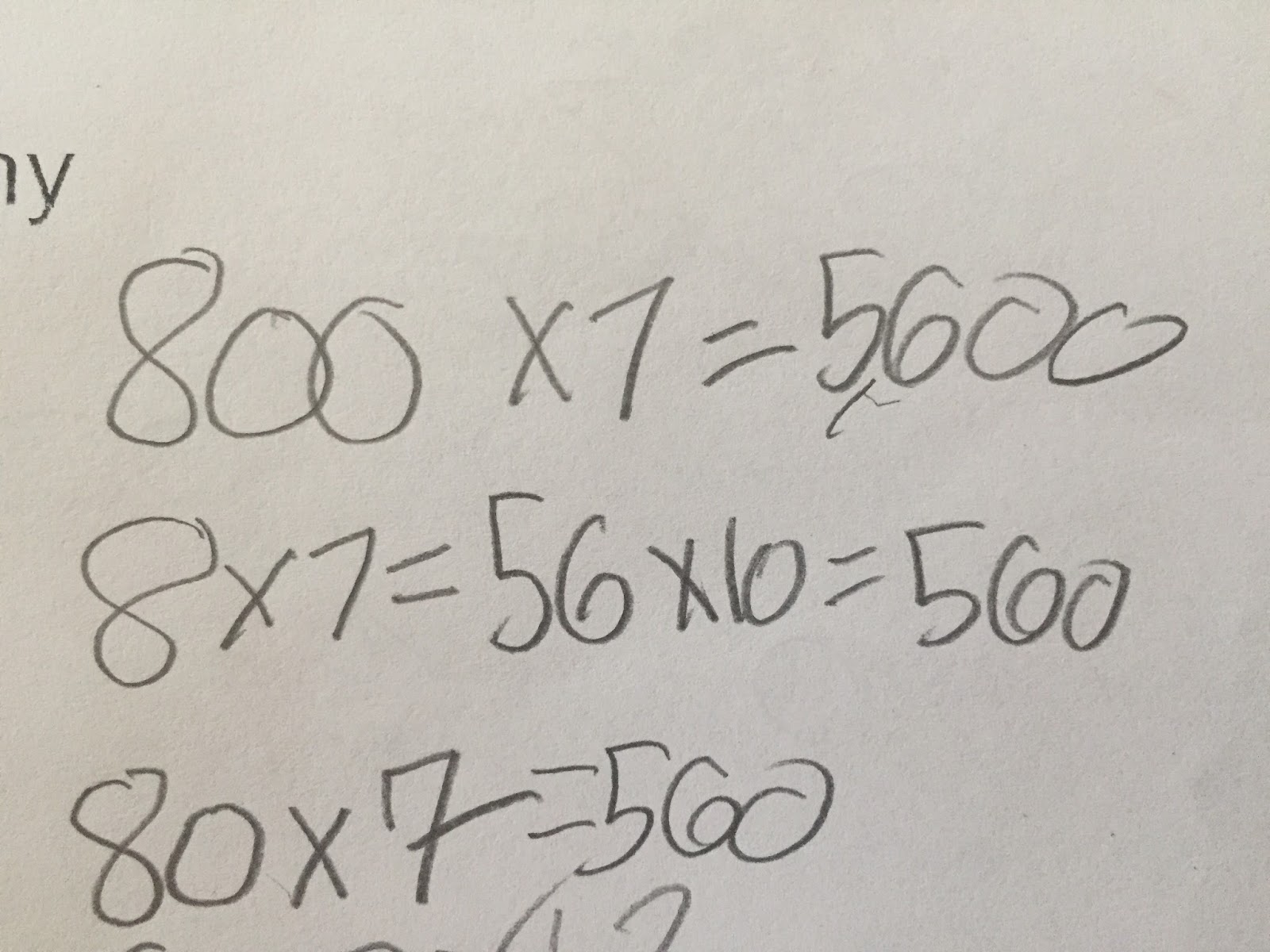
After these conversations and explorations, I've been looking to see what my students do when multiplying 4 digit numbers by 1 digit numbers. Last week, when I took their work home to look at, I found this (as one step of a longer problem):


Many Tweeps wondered what this student, who I'll call Shayla, was thinking about, so the next day I asked her. I took notes, then promptly lost my notes, then asked her to repeat her explanation. Each time I beckoned her over she rolled her eyes, but she smiled too. She liked knowing a bunch of teachers were wondering about her thinking.

"Well," she said, "2 x 7 is 14, and 14 x 10 is 140, which is the same as 20 x 7. And 140 x 10 is 1,400, which is the same as 200 x 7. And 1,400 x 10 is 14,000, which is the same as 2,000 x 7, which is what I figuring out."

"How did you decide how many times to multiply by 10?" I asked.

"Umm, because there were three..." she trailed off, her finger waving above the zeros in 2,000. "I don't know what to call these. The two was three..."

"Sometimes we call them 'places,'" I suggested. "You know how we say this is the ones place, and this is the tens place, and this is the hundreds place. Does that sound right?"

"Yes," she said. "There were three places here before the 2. So I multiplied by 10 one time for each place."

"And why did you put three checks there?" I asked, because some of us had wondered if she put them there to keep track of the "places."

"Because Aliyah and I got different answers, so we were checking it over and over again to figure out where we made a mistake," she explained in a tone that said this is so obvious.

Here is the whole of her work on that problem:


[Here is the slideshow about refugees arriving in Europe via the Mediterranean Sea, which connects to our social studies unit on immigration.]

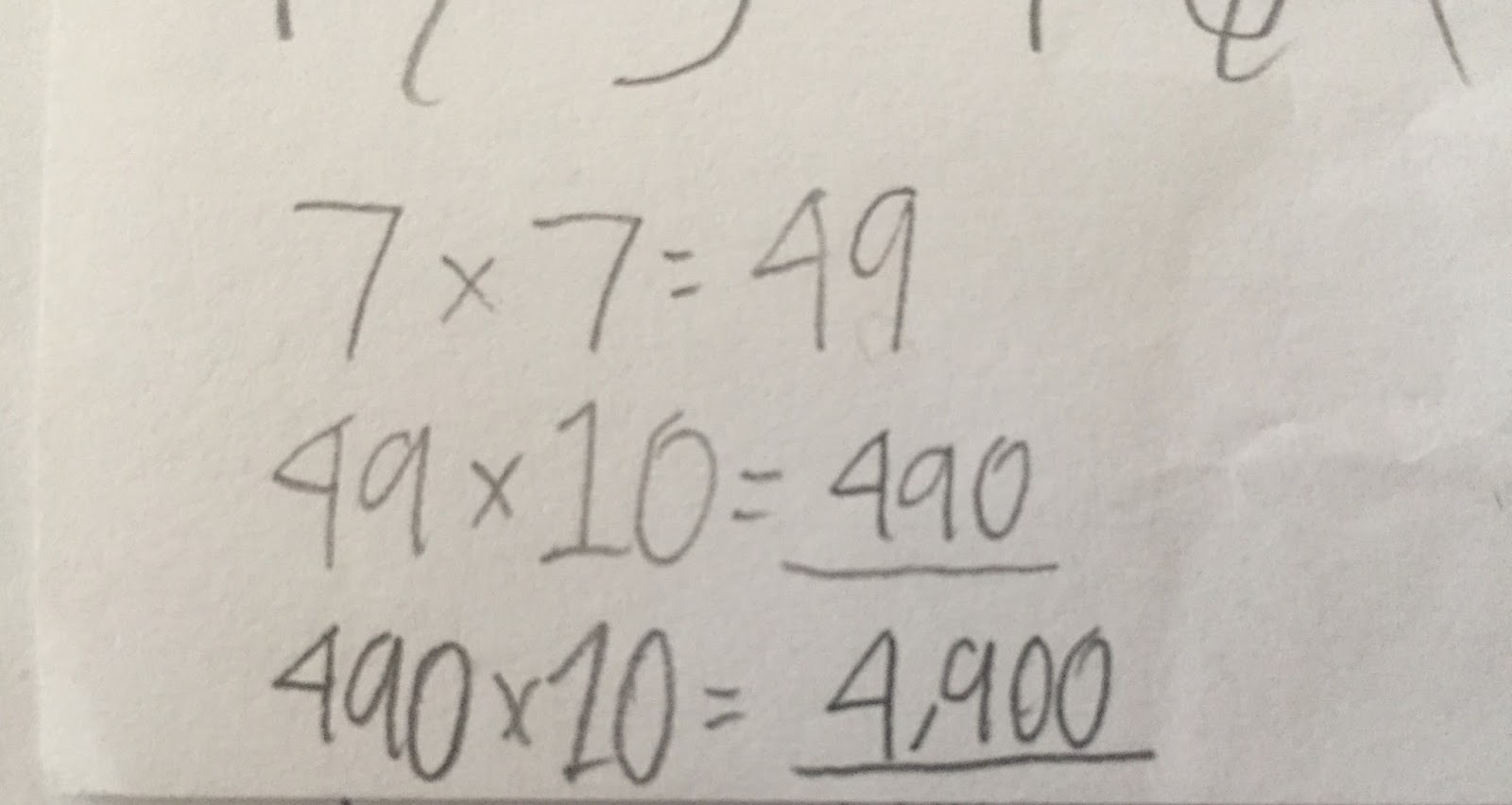
Here's what's interesting to me about this: once again, I thought that if students saw this pattern one or two times, they would internalize it and trust it, and not need to go through all those steps of repeatedly multiplying by 10. Some of my students don't need to go through these steps, but there are maybe 5 or 6 who are doing this each time they have to multiply a 4-digit number. Here are a few examples:


They don't trust the pattern yet. This is just like first graders who need to count groups of 10 by ones over and over again until they finally trust that a group of 10 is always a group of 10. They need to go through that process enough times, and they need to be given that time.

The other night, when I found myself solving problems in base 2 through the Exploding Dots project, I found that I didn't trust the pattern either. I needed to walk through each step for each problem. If someone had told me I had to skip the steps I wanted to go through and following a quicker procedure, I could have followed the procedure, but I wouldn't have understood it deeply.

The next day, by the way, here's what Shayla did:


She's starting to be able to skip a few steps. Trusting the pattern. But in 8 days, I won't be her teacher anymore, and I shudder to think how quickly another teacher will tell her, as she faces bigger factors, that she can just "add zeros" for each place. 

Thursday, April 27, 2017

Just Right Conjectures


We are winding up our fractions unit, having ended with adding, subtracting, and multiplying fractions. Today my student teacher Alex led class, and she asked students to think about how operations with fractions are the same or different from operations with whole numbers.

This is a pretty wide and deep question. I watched curiously to see what would emerge.

Students turned and talked with a partner. The two boys next to me sat together quietly. They looked at the board, around the room, and fidgeted. When I asked what they thought, they responded with, "What's the question?"

Around us, pairs were talking animatedly, but I couldn't hear what they were saying, although I caught words like "multiplication" and "denominator." At least they seemed to be talking about math.

"Okay," Alex said, "What did you come up with?"

Vanessa started us off. She had several false starts, and other students kept breaking in to tell her what she was trying to say. Alex quieted them, and I sat poised with the marker, ready to write whatever Vanessa said.

"When you add a fraction to a fraction," she said, "you add the numerators, and the denominator stays the same. Well, if the denominators are the same, that's what happens."

That's not a very sophisticated conjecture, was my first, uncontrolled mental response. Or it sounds like a procedural trick someone taught her. But I knew it wasn't. Vanessa was making sense of fractions for herself, stating a pattern she had noticed. I thought back to the first day we had added fractions, when she had carefully added the numerators and the denominators like this: 2/4 + 1/4 = 3/8, until I asked her to draw a model.

Vanessa continued. "Also, when you add a fraction to a mixed number, you get a mixed number that is greater than the fraction you started with."

Again, my immediate mental reaction was to be unimpressed. I kept my mouth shut and wrote.

Having finished, Vanessa turned around to see who wanted to respond. She called on Amit.

Amit shared a conjecture that some students had started talking about a few days earlier. "When you multiply a fraction by a whole number, your answer is more than the fraction and less than the whole number. But when you multiply two whole numbers, the answer is more than both the numbers."

As I wrote what he said, I asked if I could change the word "more" to "greater." I paused when I got to the word "answer."

"Is there another word we could use for answer, when we are multiplying?" I asked.

"Product," several voices chimed, so I used that instead. I paused again before writing "both the numbers."

"Do you remember that those numbers you are multiplying together are called factors?" I asked. The word factor is familiar enough to our class that they nodded, and I made the substitution.

We didn't dig into this idea more. Amit called on another student, who shared another seemingly simple conjecture: "If you add a whole number to a fraction, the answer will be a mixed number made up of the whole number and the fraction."

I asked if anyone knew what the "answer" was called when you add two numbers. "Product!" Amit said. "No," Jonelle corrected him. "Sum." I wrote sum and went back to add it to the second conjecture on our list as well.

Aliyah shared next. "If you subtract a fraction from a whole number," she began, "the answer will be a fraction."

I mentally paused as I began to write her idea down. Was this true?

I took a second to introduce the word "difference" (mentally chiding myself for never making a chart of these terms for students to refer to).

"But if you subtract a whole number from a fraction," she continued, "you can't really do that."

There was a thoughtful moment of silence, then hands started to wave and voices started to rise.

"Go ahead, Aliyah," I said, "Call on someone."

"You CAN subtract a whole number from a fraction," Joseph said. "If I have 12/8, I can subtract 1."

"Oh, I meant if you were using a fraction that was LESS than 8/8," Aliyah clarified.

"Less than 1," Sandy added.

"So you're saying you can't subtract a whole number from a fraction less than 1," I repeated back.

I wracked my brain for exceptions. On the surface it made sense. But was I going to mess up those middle school teachers if I agreed that you couldn't do it? Should I bring up negative numbers? That was NOT what we were trying to learn about today.

I kept my mouth shut and wrote.

"No!" Sean exclaimed excitedly. "If you subtract a whole number from a fraction less than 1, you get a negative number!"

"Yes! That's right!" several other kids clamored.

"What? What is a negative number?" Skye asked.

Alex jumped in and drew a quick number line on the board. She started to explain, but students excitedly took over her explanation. (They think negative numbers are SO neat!) She wrote in several whole numbers greater than and less than zero and asked what the kids noticed. "It's like a mirror!" someone said.

Alex then added fractions between the whole numbers, greater than and less than zero. Many students started talking at once with questions and observations.

We had to make a choice. I looked at Alex. We stopped them. Back to fractions.

"How should we word this, then?" I asked, and I took suggestions from the class about what to cross out and change. I drew a small number line to illustrate the conjecture. And our time was up -- in fact, math had gone twenty minutes over.

I loved that some students could generalize like this. And I wondered about others, like the two boys I sat with during the turn and talk, who didn't talk at all during this conversation, and mostly fidgeted, heads down.

I spent some time thinking about my mental reactions to these ideas, the fact that my mind kept wanting more sophistication out of these ten year olds. Looking back at the list, I could see that these weren't simple ideas. They were the ideas they were beginning to really solidify for themselves about fractions. They were Just Right Conjectures, for them.

Unsure of what should be my next step (especially considering we are at the end of our time for fractions and have so much to move on to before the end of the school year), I got some advice from Kristin Gray and Jamie Garner.


I'm excited to see what they come up with.

I'll be the teacher in the corner with her mouth shut, writing.

Sunday, October 16, 2016

Differentiation in Math Class: Centers

My fourth grade class is all over the map, mathematically speaking. Some are really ready to learn fourth-grade content, while others need extra support in order to do so. Still others need time to revisit concepts from earlier grades, and a final group is ready to be pushed to fifth and sixth grade math. This is a common situation in many classrooms, and it can leave a teacher scratching her head, wondering what to do each day.

One of the ways I approach this situation is to plan some days that are based around centers. I use the term “centers” loosely. Mostly what I mean is that different students are doing different things at different times, and students usually rotate from one activity, game, or group to another. Here is a portrait of how I planned such a day last week. (Thanks to @jennalaib for inspiring me to write this blog post.)

I had several groups of students to consider in planning my math class last Friday. The majority of my plan was based on the work they had done two days earlier, when my student teacher taught a lesson on prime and composite numbers.
  • Of our 24 students, she and I determined that five of them were pretty solid on determining if a number was prime or composite.
  • Sixteen others either needed more practice (they had worked slowly on Day 1, so we weren’t sure yet how facile they were at finding factors), OR we knew they needed more support from a teacher.
  • For three of our students, determining if a number was prime or composite wasn’t a good use of their time. Of these three, one has Down’s syndrome and is learning to add and subtract numbers under 20. The other two need practice with multiplying and making arrays. The visual models of multiplication are very important for them to continue to make sense of multiplication. They can work on finding factors by making arrays, and we can talk about whether a number has many or few factors, but our focus for them is more on what multiplication means than how many factors a number has.

Based on this information, I made a center plan for our 60-minute math class. We would begin with a 10 minute number talk, then students would have slightly more than 20 minutes in each of two centers. This left a few minutes to clean up and transition after each center.

I created the following plan for each group of students:
  • I started with the 16 students who needed more work on prime and composite, since that was my biggest group and my main goal for the day. I broke them into two heterogeneous groups of 8, so that each group had only 2-3 kids who would really need more intensive help from a teacher. Each of those groups would meet with my student teacher for one 20-minute “center” to continue identifying prime and composite numbers.

    Their second center would be to meet with me for a discussion about finding factors. This was meant to be a whole-class conversation, according to our curriculum, but participation has been somewhat limited during whole-class conversations in my class so far this year. (I think this will get better as we get deeper into the year.) Plus, I wanted to be able to support different students to access my questions in different ways (questions like, “Is 3 a factor of 51? Is 6 a factor of 86?”). I thought this would be easier in small groups than in a whole class format.
  • My student who is working on counting and adding small numbers also had two centers. The first was to work one-on-one with my co-teacher (the special educator). I asked them to solve some addition and subtraction problems about making jewelry with beads and for my co-teacher to take some notes for me so I could know what strategies she was using and if these problems (with totals under 30) were the right level of difficulty for her.

    Her second center involved learning an Investigations game from the first grade curriculum called Five in a Row. This game has many versions that vary in difficulty, so I wanted her to learn the most basic version so she could play it all year, progressing from the easier version to harder ones involving adding 3 numbers or subtracting. I partnered her with a peer to learn this game on the computer. I rotate kids through working with her, usually for 20-30 minutes at a time so they don’t miss too much of their own math work. This is good pro-social time for her as well as good math practice.
  • The two boys who are working on understanding multiplication better did something similar. They also played an online game, this one from the third grade Investigations curriculum (Multiplication Compare). I had taught it to them the day before. For their second center, they worked with my co-teacher and she taught them to play How Close to 100? She took detailed notes on how they did. Her notes, indicating that the game was too hard for one of the boys, led me to create a modified version of the game for him to try this coming week.
  • Finally, the 5 students who were solid on finding prime and composite numbers had a choice of 3 multiplication / factoring games to play: a fourth grade Investigations game called MultipleTurnover; the Product Game; and Factor Find from Origo. They stayed with the game for both their centers.


So how did it all go? Mostly, it went great. Here are the highlights:
  • The room had a busy hum throughout the workshop and everyone, with the exception of one student, was working nearly the whole time.
  • My student teacher got to work with a few students who needed more practice with prime / composite and they made good progress. She took notes for me on their work in a Google doc.
  • My co-teacher took detailed notes about the three students she worked with, which helped me think about the next steps for all of them. She could focus deeply on each of them because she had them in such small groups.
  • Because the two groups of 8 were heterogeneous, both my student teacher and I were able to give students the right amount of attention. If we had had 4 or 5 students who were struggling with the content in either of those groups, it would have been overwhelming to attend to their needs. This way, we each got to check in with those who needed our attention.
  • Because these groups were heterogeneous, the level of engagement was high. My small-group conversations about factors were really rich, and I was fascinated at how quickly students took up my questions and ran with them, taking the work in whatever direction made sense to them with only a few small nudges from me. Students really pushed each other’s thinking in these conversations.

What could have been better?
  • The student who played Five in a Row had a hard time understanding the game. It would have been better if an adult had taught it to her with the peer, rather than asking the peer to introduce it on her own. After some time with an adult, the two of them could have carried on playing independently.
  •  The two boys who played Multiplication Compare played it for some time, but by the end of the 22 minutes had started playing a different (non-math) online game. (The temptations of the Internet!) Invariably during a center-based math class, students must work independently, and some are more able to do so than others.
  • The five students who got to choose a game had no time with an adult. I didn’t get to see what strategies they were using or ask them questions about their thinking. For one day, this was fine, but I have to be careful that students who have mastered the content don’t end up working independently most of the time. The next time we do centers, I’ll be sure to spend time with each of them.
  • This kind of teaching is a lot of prep. Luckily, a lot of these math games are online through our curriculum. Otherwise, I would have been pulling together tons of cards, dice, directions, etc. It’s important that my students have a repertoire of games with which they are familiar so that I can give them choices during centers and I have less prep. I have plastic boxes set up with the materials for all the non-computer games that I can quickly grab in the morning, and I have created tiny urls for the online games so they can access them easily. While some center material is new each day or two, other things are recycled and re-used, which cuts down on prep.


I don’t have three adults in the classroom every day, so on some days more kids would have to work independently. But the days when there are three of us are great days to do centers with purposefully planned small groups.

Saturday, September 17, 2016

Forging a New Identity

We've been in school for seven days. We've had seven days to start to get to know Diego, who is new to our school and to our fourth grade class. (His name and the details of his story have been changed. The traits I describe here are not true of the real student, but they give a sense of what his school experiences have been.) When his dad brought him into our class on Day 1, he said, "He's had a hard time in school." Diego turned his back to me and asked his dad to take him home.

Since then, he's been very quiet, rarely speaking during academic times. He is sometimes rude, perhaps unintentionally, when he does speak. He loves to run and jump, even in the classroom. He has broken a few of my things, sometimes on purpose. We are working hard to figure out what makes him tick, what kind of a learner he is, and what his strengths are.

Yesterday in math class, we talked about how good it is for our brains when we connect images, designs, colors, pictures, and patterns to numbers. Then we looked at pictures of arrays in real life. Students had a choice to look for arrays in the classroom, draw arrays they could think of (such as an egg carton), choose a photo of an array I had brought, or build their own arrays from tiles or wooden circles (made by Chris Danielson of Talking Math with Your Kids.) They worked on finding out the dimensions of their array and how many were in it total, then drawing a picture of it.

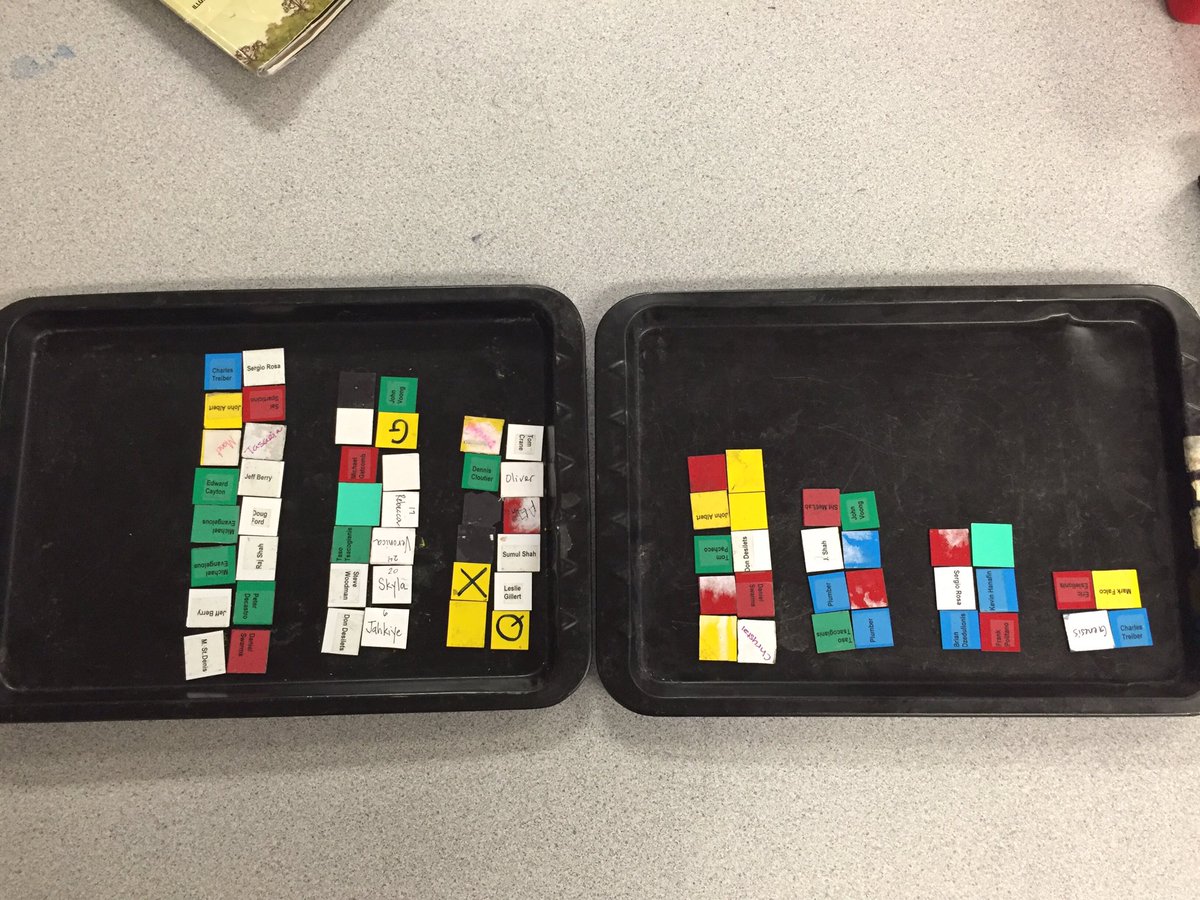
Here is what Diego made. His own idea, with very little input, working from right to left.


This is so awesome for our math thinking and math community. Here's why.

The image of his work is a perfect starting place for all kinds of questions for kids learning math at all different levels. I can offer many questions and prompts and let students choose what to work on.
  • What do you notice and wonder about Diego's work? (This is where I will start, with the whole class.) 

Then students can pursue any of these questions, plus those they come up with themselves:
  • How many are in each array? What kind of a multiplication equation could represent each array? 
  • Try turning the arrays on their sides to see if the products are the same. 
  • Make predictions about what would come next if you continued the pattern, then build it to check your predictions. 
  • Make predictions about how the pattern will change as it moves left, even very far to the left. (Thanks to Pierre Tranchemontagn for this idea.)

I have one student doing math at a K / 1st grade level. She can count how many squares are in each array and write the total underneath. 

Even more, though: When we highlight Diego's work, and make it the subject of our amazement, wonder, and further inquiry, we will give him an identity as a mathematical thinker. I suspect this will be new for him. And it will be an important first step as he starts his year in a new class, at a new school, with hopefully a better school experience than what he's had before. He's mostly been known in school as someone who makes trouble and needs help. How will it feel to him to be known for a novel idea that is fodder for the mathematical thinking of 23 other kids?

And to the rest of the fourth grade teachers: I know we made a plan for next week. Sorry that we'll be diverging from that plan. Something came up.